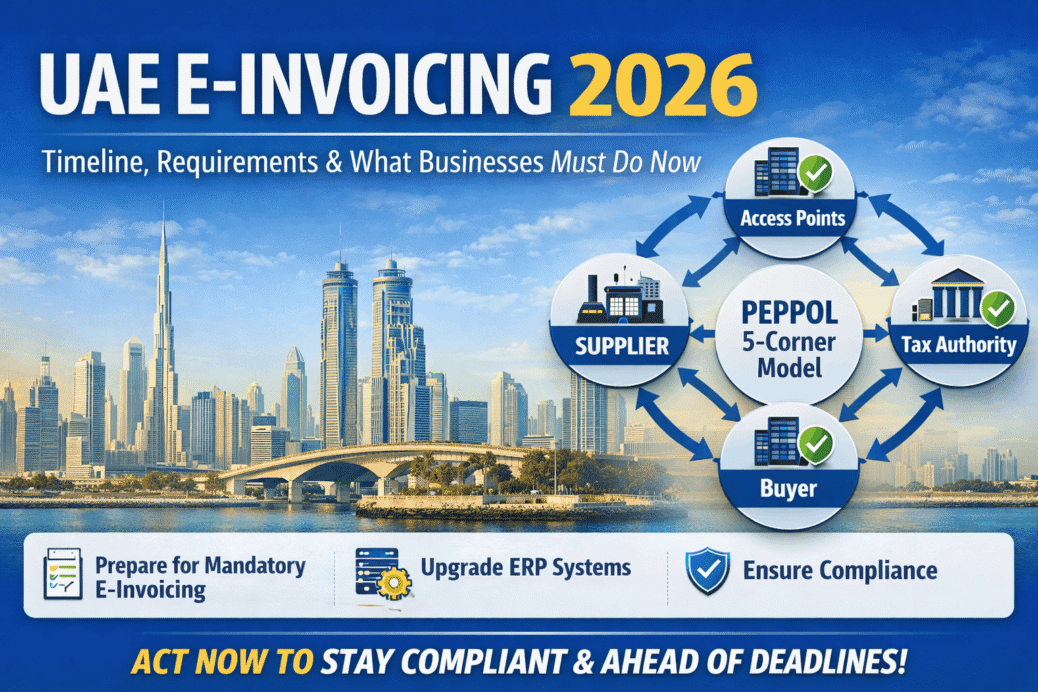
The Clock Is Ticking: Are You Ready for UAE E-Invoicing 2026?
The UAE is moving toward mandatory e-invoicing.
For many businesses, this sounds like “another regulatory update.” But it isn’t.
This transformation will fundamentally change how invoices are issued, validated, exchanged, archived, and reported to the tax authority. Companies that delay preparation risk:
-
Disrupted cash flow
-
Rejected invoices
-
Compliance penalties
-
Operational chaos
-
ERP integration challenges
The businesses that act now will gain faster payments, automated compliance, real-time tax visibility, and a competitive edge.
This guide breaks down everything you need to know about UAE E-Invoicing 2026, including timelines, technical architecture, compliance requirements, and exactly what your business must do now.
What Is UAE E-Invoicing 2026?
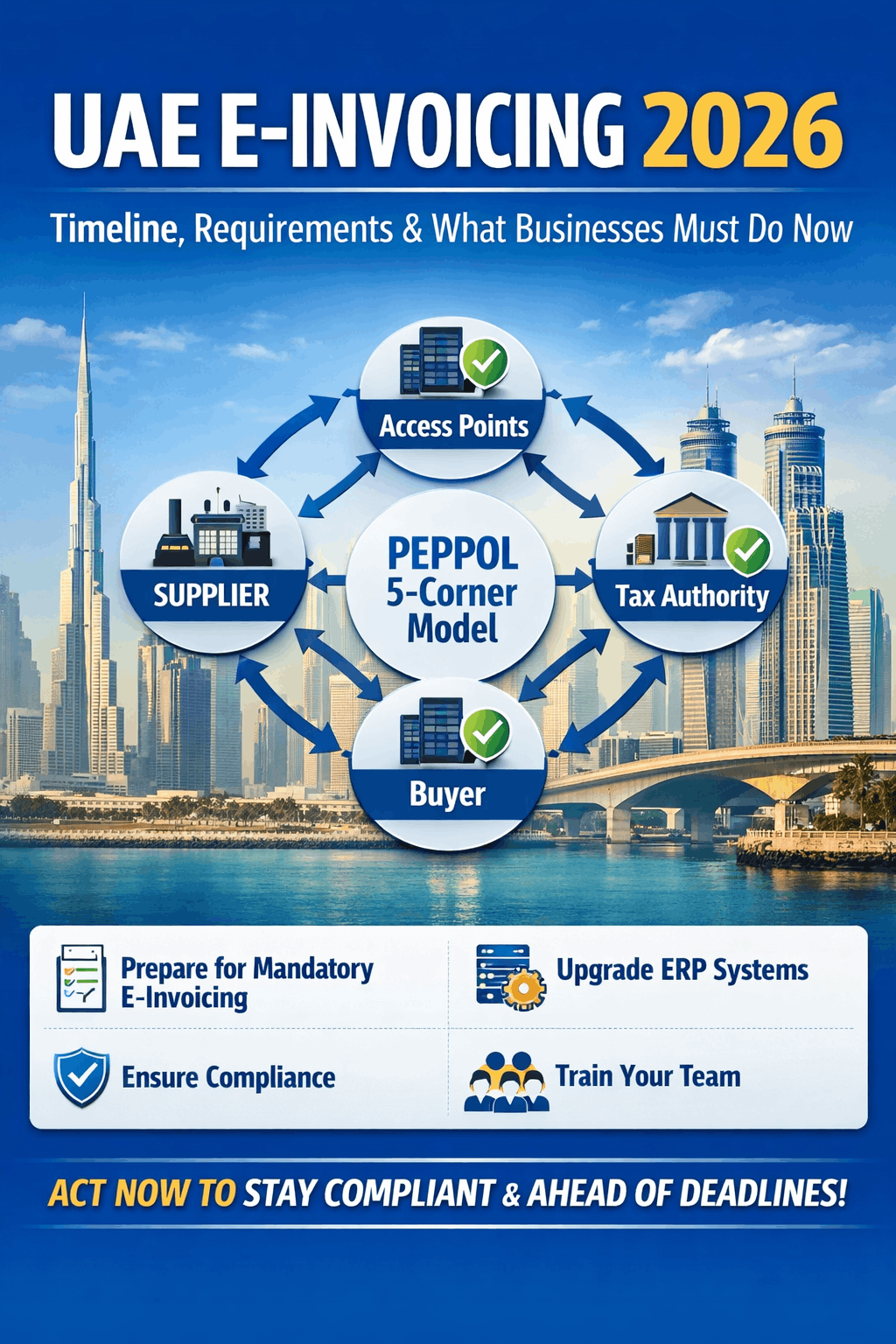 The UAE is implementing a structured electronic invoicing framework under the supervision of the Federal Tax Authority (FTA). Instead of sending PDFs or paper invoices, businesses will exchange structured electronic invoices through accredited platforms using a regulated interoperability model.
The UAE is expected to adopt a PEPPOL-based 5-corner model, ensuring secure, standardized, and real-time invoice exchange between trading partners.
This is not just digitizing invoices.
It is:
-
Standardized structured data (XML/UBL format)
-
Secure transmission via certified Access Points
-
Tax authority visibility
-
Interoperability across borders
-
Compliance by design
UAE E-Invoicing Timeline: What We Know So Far
While final rollout phases are expected to be confirmed by regulators, the general progression follows global best practices observed across Europe and GCC markets.
2024–2025: Framework & Accreditation Phase
-
Regulatory framework publication
-
Accreditation of Service Providers (ASPs)
-
PEPPOL-based infrastructure setup
-
Technical specifications release
2025: Pilot & Early Adoption
-
Selected businesses onboarded
-
Testing of interoperability
-
Validation mechanisms refined
2026: Phased Mandatory Rollout
-
Large enterprises first
-
Mid-sized businesses next
-
SMEs following in stages
Businesses operating in KSA have already seen how quickly mandates become enforceable under ZATCA. The UAE trajectory is expected to be structured but decisive.
Understanding the PEPPOL 5-Corner Model
The UAE model is expected to align with the global PEPPOL (Pan-European Public Procurement Online) framework.

What Is PEPPOL?
PEPPOL is a secure international e-document exchange network governed by OpenPeppol. It ensures that invoices move in a standardized format between verified participants.
The 5-Corner Model Explained
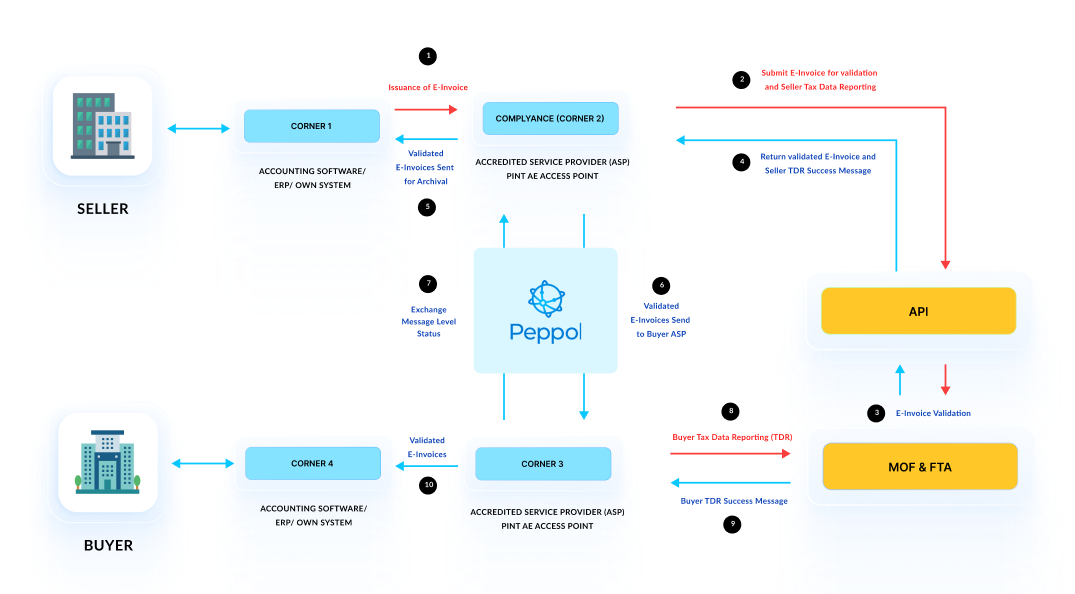
Traditional models involve 3 corners (buyer, seller, and access points). The UAE is expected to implement a 5-corner Continuous Transaction Control (CTC) model, adding regulatory oversight.
The five corners include:
-
Supplier
-
Supplier Access Point
-
Buyer Access Point
-
Buyer
-
Tax Authority / Central Platform
This ensures:
-
Invoice validation
-
Compliance monitoring
-
Fraud reduction
-
Real-time reporting
Old vs. New: PDF Invoices vs. UAE PEPPOL E-Invoicing
| Feature | Traditional PDF Invoices | UAE PEPPOL E-Invoicing |
|---|---|---|
| Format | Unstructured PDF | Structured XML/UBL |
| Validation | Manual | Automated system validation |
| Transmission | Secure Access Points | |
| Compliance | Post-audit | Real-time validation |
| Error Handling | Manual corrections | Instant rejection & correction |
| Interoperability | Limited | Global PEPPOL network |
Bottom line: PDFs are documents. PEPPOL invoices are data.
Why UAE Businesses Must Prepare Now
Global data from markets with e-invoicing mandates shows:
-
Faster payment cycles
-
Reduced invoice disputes
-
Significant reduction in VAT errors
-
Lower fraud exposure
In countries that implemented CTC models, tax gap reductions were substantial within the first few years.
Businesses that prepare early benefit from:
-
Controlled ERP integration
-
Staff training
-
Vendor coordination
-
Avoiding last-minute compliance pressure
What UAE Businesses Must Do Now (Action Plan)
1. Conduct an E-Invoicing Readiness Assessment
Evaluate:
-
ERP capability (SAP, Oracle, Dynamics, custom systems)
-
Invoice volumes
-
B2B vs B2G exposure
-
Current VAT reporting processes
-
Master data accuracy
Internal linking opportunity: “e-invoicing readiness assessment in UAE”
2. Understand Data Requirements
Structured invoices require:
-
VAT registration numbers
-
Correct tax codes
-
Standardized line item descriptions
-
UBL-compatible formatting
Data cleansing is critical.
3. Choose a PEPPOL-Enabled Access Point Provider
Your provider must:
-
Be accredited
-
Support UAE regulatory requirements
-
Ensure interoperability
-
Offer ERP integration APIs
-
Provide secure archiving
Internal linking opportunity: “PEPPOL Access Point provider in UAE”
4. Upgrade or Integrate Your ERP System
Integration should support:
-
XML generation
-
Real-time validation
-
API connectivity
-
Digital signatures
-
Audit trails
5. Train Finance & IT Teams
Compliance is not only an IT project.
Finance, tax, operations, procurement, and IT must align.
Real-World Use Cases
Construction Company in Dubai
-
High invoice volume
-
Multiple subcontractors
-
Cross-border suppliers
With PEPPOL integration:
-
Automated tax validation
-
Reduced dispute cycles
-
Faster project billing
Retail Distributor
-
Thousands of B2B transactions monthly
E-invoicing reduces:
-
Manual reconciliation
-
VAT mismatch errors
-
Fraud risks
Healthcare Provider
-
Sensitive financial data
-
Strict regulatory compliance
Structured e-invoicing ensures:
-
Secure exchange
-
Audit transparency
-
Automated reporting
Technical Deep Dive: Interoperability & Compliance Framework
The UAE model is expected to focus on:
- Interoperability – Ensures all systems “speak the same language” using standardized UBL formats.
- Continuous Transaction Controls (CTC) – Invoices are validated before or during transmission, not after.
- Accreditation Framework – Only approved service providers can operate as Access Points.
- Secure Transport Protocols – Likely AS4 protocol used in PEPPOL.
- Digital Archiving – Long-term storage compliant with UAE VAT regulations.
Common Risks If You Delay
-
ERP incompatibility discovered too late
-
Vendor onboarding delays
-
Failed invoice validation
-
Business disruption
-
Emergency implementation costs
Reactive compliance is always more expensive than proactive planning.
Frequently Asked Questions
1. Is UAE e-invoicing mandatory for all businesses?
It is expected to be rolled out in phases, starting with larger enterprises before expanding to SMEs.
2. Will PDFs still be allowed?
Structured electronic invoices will become mandatory for compliance. PDFs may exist as human-readable copies but not as the legal invoice format.
3. Is UAE adopting the same model as Saudi Arabia?
The UAE is expected to follow a PEPPOL-based interoperability framework, while Saudi Arabia operates under ZATCA’s CTC model. Both focus on real-time validation but differ technically.
4. Does this affect cross-border transactions?
Yes. PEPPOL enables cross-border interoperability, making international invoicing more seamless.
5. How long does implementation take?
For mid-to-large enterprises, preparation may take several months depending on ERP complexity.
The Strategic Advantage of Early Adoption
Forward-thinking businesses view UAE E-Invoicing 2026 not as a compliance burden, but as:
-
A digital transformation catalyst
-
A tax risk reduction strategy
-
A finance automation opportunity
-
A competitive differentiator
The earlier you align systems, data, and teams, the smoother your transition.
Why Choose VFTWorld for UAE E-Invoicing?
At VFTWorld, we provide:
-
UAE FTA-aligned compliance solutions
-
PEPPOL Access Point connectivity
-
ERP integration services
-
Multi-country readiness (KSA ZATCA, Qatar, Bahrain, Oman, GCC, Europe)
-
Secure cloud-based infrastructure
-
End-to-end implementation & support
We do not just connect systems.
We build compliance ecosystems.
Final Thoughts: 2026 Is Closer Than It Looks
Regulatory deadlines move fast.
Businesses that prepare in 2025 will transition smoothly.
Businesses that wait will scramble.
UAE E-Invoicing 2026 is not optional. It is inevitable.
Now is the time to assess, plan, integrate, and lead.
Ready to Become Compliant Before the Mandate?
Explore VFTWorld’s complete UAE E-Invoicing Solution today and position your business ahead of regulatory deadlines across UAE FTA, KSA ZATCA, Qatar, Bahrain, Oman, GCC, and global PEPPOL frameworks.
Compliance is coming. Leadership is a choice.