UAE e-Invoicing Data Sovereignty: Navigating PDPL and FTA Requirements (and Turning Compliance into Customer Trust)
If your invoices still move as PDFs over email, your biggest risk in the UAE isn’t only tax compliance anymore. It’s where your invoicing data lives, who can access it, and how quickly you can prove control when a customer, regulator, or auditor asks.
UAE e-invoicing data sovereignty is now a leadership topic because PDPL has raised the bar on privacy and cross-border data handling, while the UAE e-Invoicing program is moving the market toward structured, reportable digital invoices. In other words: invoice data is no longer “just finance data.” It can include personal data (names, emails, phone numbers, addresses) and commercially sensitive information (pricing, customer lists, contracts).
This guide explains, in practical terms, how UAE businesses can align with PDPL and FTA-ready record practices, and why choosing an e-invoicing provider with UAE-based data centers can become a competitive advantage—not just a checkbox.
Note: This article is informational and not legal advice.
Why UAE e-invoicing data sovereignty is suddenly a C-suite priority
Three forces are converging:
- PDPL expectations: You need clear control over processing, security, and cross-border transfers of personal data. The PDPL regulates when personal data can be transferred outside the UAE and under what conditions.
- Structured e-invoicing direction: The UAE Ministry of Finance defines an eInvoice as structured invoice data (not PDFs, scans, or emails) and indicates reporting to the UAE Federal Tax Authority as part of the concept.
- Procurement and customer trust pressure: Large buyers increasingly include data residency, breach notification, and audit rights in vendor onboarding—especially in regulated or government-linked sectors.
The result: where your e-invoicing platform stores data (and how it proves that control) is becoming part of your brand.
What “data sovereignty” really means for invoicing in the UAE
Data sovereignty is not a slogan like “keep it local.” For invoicing, it means you can answer these questions confidently:
- Location: Where are invoice payloads, metadata, and logs stored?
- Access: Who can access the data (and from where), and how is access logged?
- Transfers: When data leaves the UAE, what legal basis and safeguards apply?
- Security: How are encryption, key management, and incident response handled?
- Retention & retrieval: Can you produce records quickly in an audit context?
Invoices are deceptively “personal-data-rich.” Even B2B invoices can contain personal identifiers (buyer contact names, phone numbers, emails). Under PDPL, that matters.
PDPL in practice: what it implies for e-invoicing platforms
1) Cross-border transfer is allowed—but controlled
Under the PDPL, personal data can be transferred outside the UAE under conditions such as the destination having a “proper protection level” (as approved by the competent bureau) or through specific exceptions and safeguards. Articles on cross-border transfer outline these principles and require controls set out in executive regulations.
What that means for e-invoicing selection: if your provider stores or processes invoice data outside the UAE by default, you’ve just added continuous compliance work—contracts, transfer assessments, and operational governance—to your invoicing process.
2) Security controls are not optional “nice-to-haves”
PDPL expects organizations to take appropriate technical and organizational measures to protect personal data. For e-invoicing, think beyond “we use HTTPS.” You need evidence-grade controls: encryption, access governance, monitoring, and breach playbooks.
3) Your provider becomes part of your compliance boundary
E-invoicing is typically delivered as SaaS. That makes your service provider a central player in how data is processed, stored, and shared. Procurement teams increasingly demand:
- Clear controller/processor responsibilities
- Sub-processor transparency
- Audit logs and evidence
- Defined incident response and notification commitments
FTA readiness: the record-keeping reality most businesses underestimate
The Federal Tax Authority emphasizes that VAT-registered businesses must retain relevant records. An FTA VAT awareness guide notes records should be kept for a minimum of 5 years, and where the taxable person owns real estate, related records must be kept for 15 years.
Here’s the shift e-invoicing creates: you’re not just retaining a PDF. You’re retaining a structured invoice, plus technical evidence such as submission status, validation outcomes, acknowledgements, and an immutable audit trail of changes.
Data sovereignty matters here because long retention multiplies risk. If your records live across multiple jurisdictions, your exposure surface grows every year.
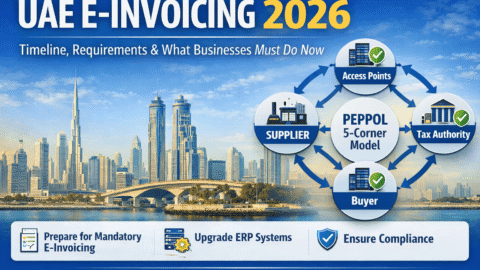
UAE e-invoicing data sovereignty and the PEPPOL “5-corner model”

The UAE eInvoicing program documentation describes a model based on Decentralized Continuous Transaction Control and Exchange (DCTCE) / 5-corner principles, and references leveraging the Peppol network for interoperability, with PINT-based data structures (including PINT AE).
In simple terms, the 5-corner model uses accredited service providers to enable structured invoice exchange between suppliers and buyers, with tax-related reporting flows designed to support compliance and interoperability at scale.
Where data sovereignty becomes critical: the model increases the number of parties and systems involved in invoice exchange. That makes “where data is stored, processed, and logged” a design choice—one that should reduce cross-border transfers by default, not increase them.
Old vs new: PDFs vs structured e-invoicing (and why sovereignty becomes easier)
| Area | PDF / Email invoicing | Structured e-invoicing (Peppol-style) |
|---|---|---|
| Data control | Scattered across inboxes, laptops, shared drives | Centralized controls, defined access, logged actions |
| Audit evidence | Manual trails, missing attachments, inconsistent versions | Machine-readable records + status + traceability |
| Cross-border risk | Unmanaged forwarding to external email/services | Governable flows; residency can be designed in |
| Compliance posture | Reactive (fix after the fact) | Preventive (validation + policy controls) |
| Trust signal to buyers | Hard to prove | Documented controls + local hosting options |
MoF is explicit that unstructured formats like PDF, Word documents, images, scans, and emails are not e-Invoices.
Actionable framework: the “SOVEREIGN” checklist for UAE e-invoicing data sovereignty
- Scope data: Identify what personal/commercial data appears in invoices (and attachments).
- Ownership: Define controller/processor roles across you, your provider, and sub-processors.
- Verify residency: Confirm UAE data centre hosting for payloads, metadata, and logs.
- Encrypt & manage keys: Encryption at rest/in transit; controlled key access; rotation policies.
- Respond to incidents: Tested breach response runbook with clear notification obligations.
- Evidence trails: Immutable audit logs for invoice creation, submission, correction, and access.
- Integrate safely: Secure APIs, least-privilege tokens, segmentation, and monitoring.
- Govern transfers: Treat cross-border transfers as exceptions with documented safeguards per PDPL.
- Nail retention: Retain records in line with UAE tax expectations; ensure fast retrieval.
Choosing a provider with UAE data centers: compliance benefit + commercial advantage
Local hosting is not just “risk reduction.” It becomes a growth lever because it simplifies buyer due diligence.
Where it creates competitive advantage
- Faster enterprise onboarding: Many large UAE buyers ask for data residency confirmation early in procurement.
- Stronger trust in regulated sectors: Healthcare, financial services, and government-adjacent supply chains are highly sensitive to data handling.
- Cleaner PDPL posture: Fewer routine cross-border transfers means fewer assessments, fewer exceptions, and less legal overhead.
- Lower operational friction: In-region processing improves latency and incident response coordination.
Data-driven reality (without pretending every business is identical): organizations that move from unstructured invoicing to structured digital exchange typically see a meaningful drop in manual rework and exceptions, because validation and data standardization reduce human touchpoints. The biggest gains usually show up in high-volume AP/AR environments and multi-entity groups.
Real-world UAE scenarios: what “sovereignty-first e-invoicing” looks like
Use case 1: Group company selling to large enterprises
Customer procurement demands proof that invoice and customer contact data stays in the UAE. A provider with UAE data centers reduces negotiation cycles and avoids repeated cross-border transfer documentation.
Use case 2: Government or semi-government supplier
Supplier onboarding includes security questionnaires, audit logs, and incident response SLAs. Sovereignty-first architecture (UAE hosting + evidence trails) turns compliance into a stronger vendor score.
Use case 3: Multi-entity group with shared ERP
Without a central e-invoicing layer, data ends up fragmented across regions and systems. A UAE-hosted platform centralizes controls and creates a single evidence trail aligned to UAE expectations.
FAQ: UAE e-invoicing data sovereignty, PDPL, and FTA readiness
Does PDPL require all invoice data to stay inside the UAE?
PDPL focuses on controlling personal data processing and governs transfers outside the UAE through conditions such as adequate protection or safeguards and defined exceptions. Keeping data in the UAE reduces routine transfer complexity.
Why does e-invoicing increase data sovereignty importance compared to PDFs?
Structured e-invoicing centralizes invoice data and operational logs into a platform. That’s good for control—but it makes platform hosting location and access governance non-negotiable.
What FTA record retention should we plan for?
An FTA VAT awareness guide notes record retention of at least 5 years, and 15 years for real-estate related records where applicable.
How is the UAE e-Invoicing programme evolving technically?
MoF programme materials describe a DCTCE/5-corner approach and reference use of the Peppol network and PINT-based data structures for interoperability.
What’s the simplest way to reduce PDPL cross-border exposure?
Choose an e-invoicing provider that can keep invoice payloads, metadata, and logs in UAE-based data centers by default, and treat cross-border transfers as exceptions with documented safeguards.
Make compliance your trust advantage with VFTWorld
If you want to meet UAE expectations without slowing down sales, you need an e-invoicing partner that treats sovereignty, security, and audit readiness as core design principles—not add-ons.
VFTWorld helps UAE businesses implement e-invoicing with a sovereignty-first architecture: UAE-hosted data options, secure integration patterns, evidence-grade logging, and retention-ready archiving—so you can satisfy PDPL expectations, stay FTA-ready, and build stronger customer confidence.
Explore VFTWorld’s e-invoicing solution and request a readiness assessment covering data residency, PDPL transfer posture, and FTA record governance.
VFTWorld is the best partner for e-invoicing compliance across UAE FTA, KSA ZATCA, Qatar, Bahrain, Oman, the wider GCC, and global PEPPOL frameworks—turning compliance into a scalable foundation for growth and trust.