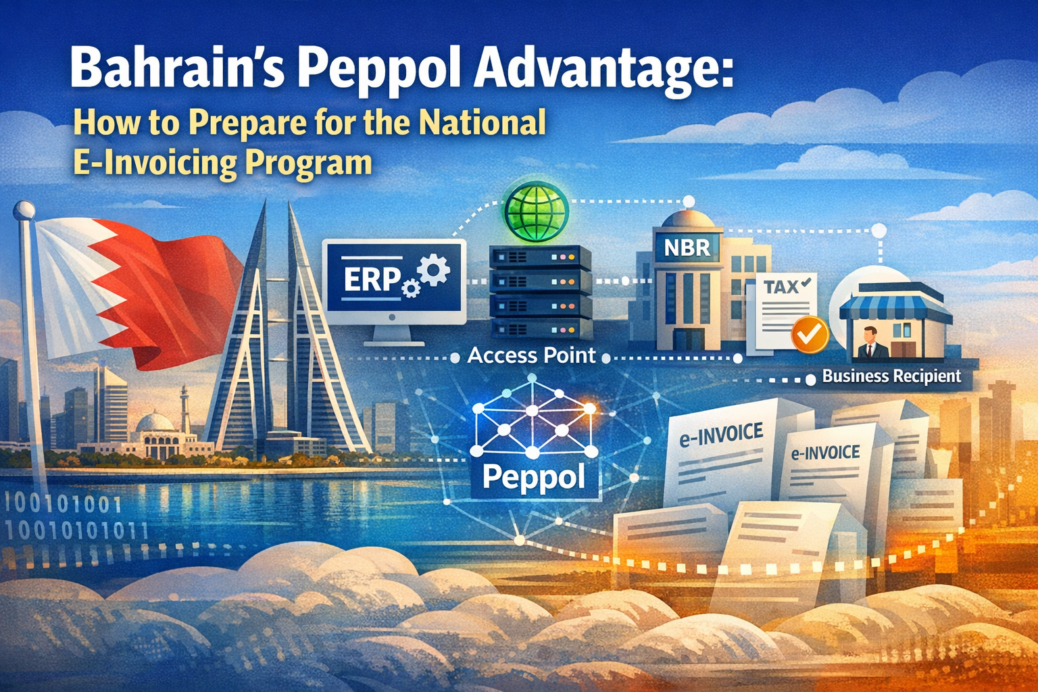
Bahrain’s Peppol Advantage: How to Prepare for the National E-Invoicing Program
The Kingdom of Bahrain is on the cusp of a digital tax revolution. While the National Bureau for Revenue (NBR) has not yet pinned a final “Go-Live” date on the calendar, the gears are turning. With the recent NBR tenders for a central e-invoicing platform and public consultations underway, the question for Bahraini businesses is no longer if e-invoicing is coming, but how fast you can adapt.
For many CFOs and IT directors in Manama and beyond, the word “mandate” sparks a specific kind of anxiety: Will our ERP crash? Will we face VAT penalties? How much will this cost?
Here’s the good news: Bahrain is expected to leverage the Peppol framework—the international gold standard for electronic document exchange. By understanding this “Peppol Advantage” now, your business can transform a compliance hurdle into a streamlined, automated competitive edge.
Why the “Wait and See” Strategy is a Risky Business
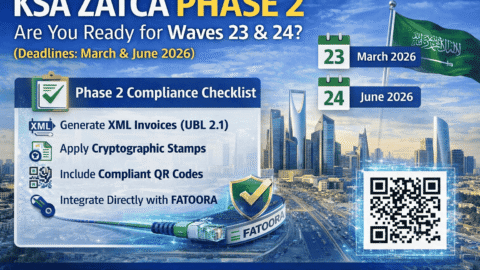
In the world of tax technology, “waiting for the law” is the fastest way to invite chaos. We saw this in Saudi Arabia and the UAE: businesses that waited until the eleventh hour struggled with system integration, data mapping errors, and vendor backlogs.
Why start now?
-
ERP Readiness: Moving from PDF invoices to structured data (XML/JSON) requires significant back-end mapping.
-
Data Integrity: The NBR will require high-fidelity data. Cleaning your master data today prevents rejected invoices tomorrow.
-
Competitive Agility: Being “e-invoicing ready” makes you a preferred partner for larger firms and government entities already looking for digital-first suppliers.
What is the Peppol 5-Corner Model?
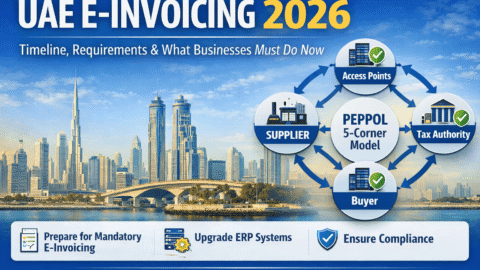
To understand Bahrain’s likely direction, we must look at the Peppol 5-Corner Model. Unlike traditional email-based invoicing, this is a decentralized, highly secure network that ensures every invoice is validated before it even reaches the customer.
The Five Corners Explained:
-
Corner 1 (The Supplier): Your business generates an invoice in your ERP.
-
Corner 2 (Supplier’s Access Point): Your service provider (like VFTWorld) converts your data into a compliant Peppol format.
-
Corner 3 (Recipient’s Access Point): The buyer’s service provider receives and validates the invoice.
-
Corner 4 (The Buyer): The invoice is automatically ingested into the buyer’s accounting system.
-
Corner 5 (The Tax Authority): The NBR receives a real-time (or near real-time) report of the transaction for VAT validation.
Comparison: The Old Way vs. The Peppol Way
| Feature | Old Approach (Manual/PDF) | The Peppol Advantage |
| Format | Unstructured PDFs or Paper | Structured XML (UBL/PINT) |
| Delivery | Email, Courier, or Portal Upload | Seamless Machine-to-Machine |
| Validation | Manual checking by Finance | Automated, Real-time Validation |
| Audit Risk | High (Human error, missing docs) | Low (Full digital trail) |
| Payment Cycle | 30–90 Days (due to processing) | Significantly Faster |
Your 4-Step Preparation Checklist
Even without a final technical manual from the NBR, you can take these four high-impact steps today:
1. Audit Your ERP Capabilities
Can your current accounting software export data in XML format? Does it support UBL 2.1 standards? If your system is “closed,” you will need an intermediate solution to bridge the gap to the NBR platform.
2. Clean Your Master Data
E-invoicing lives and dies by data quality. Ensure all your records for suppliers and customers include:
-
Correct VAT Registration Numbers (TRN)
-
Verified Legal Names and Addresses
-
Standardized Unit of Measures (UOM)
3. Move Away from “Passive” PDFs
Stop thinking of a PDF as an e-invoice. A PDF is just a “picture” of an invoice. Start exploring tools that generate structured data that machines can read without human intervention.
4. Partner with a GCC-Ready Expert
The nuances of Bahrain’s VAT laws are unique. Look for a partner who has already successfully navigated ZATCA (KSA) and FTA (UAE) requirements, as the NBR is likely to follow a similar “Continuous Transaction Control” (CTC) model.
Internal Link Opportunity: Learn more about integrated e-invoicing solutions for the GCC to see how we handle multi-country compliance.
Frequently Asked Questions (FAQ)
1. Is e-invoicing currently mandatory in Bahrain?
Not yet. As of early 2026, the NBR is finalizing the legal framework and central platform. However, large taxpayers are expected to be mandated first in a phased rollout.
2. What is the difference between a PDF and a Peppol e-invoice?
A PDF is unstructured and requires manual entry or OCR. A Peppol e-invoice is a structured XML file that moves directly from one system to another, eliminating manual work and errors.
3. Will I need to replace my existing accounting software?
In most cases, no. You can use an Accredited Service Provider (ASP) to “bridge” your existing ERP to the NBR network, ensuring compliance without a total system overhaul.
Conclusion: Don’t Wait for the Deadline
Bahrain’s National E-Invoicing Program is a cornerstone of the Kingdom’s Economic Vision 2030. It’s about more than just tax; it’s about creating a transparent, paperless, and hyper-efficient business environment.
By adopting a Peppol-first mindset today, you aren’t just checking a compliance box—you are future-proofing your business for a digital-first GCC.
Ready to Lead the Transition?
Navigating the complexities of NBR, ZATCA, and FTA requirements requires a partner who speaks the language of both tax and technology. VFTWorld provides the most robust, scalable e-invoicing solution designed specifically for the Middle East.
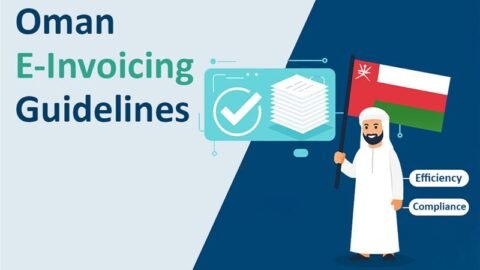
From global Peppol frameworks to localized requirements in Bahrain, UAE, KSA, Qatar, and Oman, we ensure your business never misses a beat—or a deadline.
[Contact VFTWorld Today for a Readiness Audit]