Qatar Sustainability Reporting 2026: The Compliance Shift Qatar Businesses Can’t Ignore While Waiting for E-Invoicing
If your team has been waiting for Qatar’s e-invoicing mandate to become official before investing in finance transformation, 2026 changes the timeline.
The urgent issue now is Qatar sustainability reporting 2026. Qatar’s regulators have already moved on sustainability disclosure expectations for financial institutions and listed companies, which means many CFOs, compliance leaders, and IT teams now face a different kind of reporting pressure: collecting, governing, validating, and disclosing non-financial data with the same discipline as financial data. The result is a new compliance challenge that is operational, technical, and strategic at the same time.
For B2B businesses in Qatar, this is not a side project. It is the bridge between today’s ESG and governance obligations and tomorrow’s digital tax and e-invoicing obligations.
Why Qatar sustainability reporting 2026 matters right now
Qatar’s e-invoicing timeline is still not finalized publicly, but market guidance continues to point to active preparation and groundwork rather than a finalized mandate date. That creates uncertainty for tax digitization planning. At the same time, sustainability reporting obligations are becoming much more concrete for regulated and listed entities.
This creates a practical reality for business leaders:
-
You may not have a Qatar e-invoicing go-live date yet
-
But you already have a reporting-data governance problem
-
The systems and controls you build now will directly affect future e-invoicing readiness
That is why Qatar sustainability reporting 2026 is not just an ESG topic. It is a finance-data transformation topic.
What changed in Qatar: QCB and QFMA are setting the direction
QCB Sustainability Reporting Framework raises the bar for banks and insurers
The Qatar Central Bank (QCB) published its Sustainability Reporting Framework (SRF) aligned to ISSB standards, with a clear commencement for annual reporting periods beginning 1 January 2026. The framework is for QCB-regulated financial institutions (banks and insurance companies) and sets out a phased approach using transition reliefs.
QCB’s framework explicitly aligns with IFRS S1 and IFRS S2, and requires institutions to prepare and submit sustainability reports to QCB for each annual financial year starting 2026. It also references proportionality mechanisms and transition reliefs to support implementation maturity.
A useful summary of QCB’s framework also highlights the four practical disclosure areas businesses should expect to organize around:
-
Governance
-
Strategy
-
Risk management
-
Metrics and targets
These are the same categories that typically force cross-functional coordination across finance, risk, operations, and IT.
QFMA governance code pushes ESG and sustainability disclosure into listed company reporting
The Qatar Financial Markets Authority (QFMA) issued a new Governance Code for Listed Companies (Board Decision No. 5 of 2025), and market analysis confirms the code applies mandatorily to main-market listed companies, with a compliance window of 12 months from publication (subject to extension by the QFMA Chair).
Inside the code, the sustainability angle is not optional language. The code ties disclosure policy to international governance principles including OECD and ISSB, and the governance reporting/disclosure provisions include sustainability reporting requirements and ESG indicators in the annual reporting framework. The text also references an annual sustainability report covering environmental, social, and governance indicators.
In short:
-
QCB is driving ISSB-aligned sustainability disclosure for financial institutions
-
QFMA is embedding ESG and sustainability reporting into governance and annual disclosure expectations for listed entities
-
The pressure point for both is the same: data quality, controls, traceability, and auditability
The bridge most companies are missing: ESG reporting and e-invoicing need the same data discipline
Many businesses still treat ESG reporting and e-invoicing as separate streams.
That is a mistake.
Both programs rely on the same backbone:
-
Master data quality (legal entity, branch, supplier/customer records)
-
Structured transaction data
-
Validation rules
-
Evidence trails
-
Workflow controls
-
Interoperability standards
-
Regulator-facing reporting outputs
This is why the smartest strategy in Qatar right now is to build a single compliance data foundation that serves:
-
Sustainability reporting today
-
Tax and e-invoicing readiness tomorrow
Qatar sustainability reporting 2026 and future e-invoicing: what technical teams should design for
Even though Qatar has not finalized an e-invoicing mandate date, GCC businesses should avoid building one-off reporting solutions. The region is moving toward more structured, interoperable digital compliance models.
What to keep in mind about PEPPOL and the 5-corner model
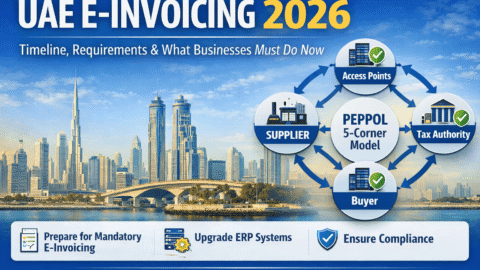
If Qatar follows the same broad interoperability direction seen in other markets, technical architecture decisions made today will matter later. In PEPPOL ecosystems, OpenPeppol describes a four-corner model at the core of the network (buyer, supplier, and their service providers).
In modern tax-reporting/e-invoicing programs, many governments extend this concept into a 5-corner model, where a tax authority or compliance platform receives transaction data or reporting feeds as part of the exchange framework. The UAE Ministry of Finance explicitly describes its eInvoicing Programme as a decentralized 5-corner (DCTCE) model using PEPPOL and PINT principles.
That matters for Qatar businesses because it gives a practical design benchmark for what “future-ready” looks like:
-
Structured invoice and reporting data
-
Standardized data dictionaries
-
Service-provider interoperability
-
Validation and routing logic
-
Compliance-grade audit logs
Tax authority validation and interoperability are not just e-invoicing concepts
Your sustainability reporting workflows should already apply the same engineering mindset used in e-invoicing:
-
Schema validation (required fields present and correctly formatted)
-
Business rule validation (e.g., emissions methodology consistency, reporting period alignment)
-
Versioning and traceability (who changed what, when, and why)
-
Submission evidence (timestamped files, approvals, audit references)
This is where many companies fail. They focus on report formatting, not on the underlying validation framework.
Old vs new approach: what has to change
Comparison table: Traditional reporting vs compliance-ready reporting
| Area | Old approach (PDF/Excel-heavy) | New approach (compliance-ready, structured) |
|---|---|---|
| Data collection | Manual requests across teams | Defined data owners and automated pipelines |
| Controls | Email approvals and informal checks | Rule-based validation and workflow controls |
| Audit trail | Hard to trace source data | Time-stamped, system-generated evidence |
| Reporting cycles | Last-minute reporting scramble | Rolling monthly/quarterly readiness |
| ESG disclosures | Narrative-first, data-later | Data-first with narrative supported by evidence |
| E-invoicing readiness | Separate future project | Built into the same finance data architecture |
| Interoperability | Static documents (PDFs) | Structured outputs aligned to standards |
| Regulator confidence | Reactive | Proactive and scalable |
A practical framework for Qatar businesses: the “Bridge Now” model
This is the approach B2B organizations in Qatar should take while the e-invoicing timeline remains open.
Phase 1: Map your compliance data landscape (30–60 days)
Start with a cross-functional map. This is usually the fastest way to expose risk.
Build a single source-of-truth map for:
-
Legal entities and branches
-
Financial reporting owners
-
Sustainability/ESG data owners
-
Risk and compliance owners
-
Source systems (ERP, treasury, HR, facilities, procurement, spreadsheets)
-
Existing approval workflows
-
External reporting deadlines
Key output: A documented compliance data inventory and ownership matrix.
Phase 2: Define your reporting controls (60–90 days)
This is where most companies move from “reporting” to “compliance operations.”
Set up a controls framework for Qatar sustainability reporting 2026:
-
Mandatory fields and completeness checks
-
Reporting period cut-off rules
-
Methodology documentation (especially for GHG-related metrics)
-
Evidence attachments and source references
-
Exception handling process
-
Approval hierarchy (preparer, reviewer, approver, compliance sign-off)
Key output: Validation and approval rulebook.
Phase 3: Build for dual use (ESG now, e-invoicing later)
Do not build separate infrastructure for ESG and e-invoicing.
Design principles to use now:
-
API-first integrations where possible
-
Structured data outputs (not just final PDFs)
-
Master-data governance
-
Immutable logs for critical compliance actions
-
Role-based access and auditability
-
Standardized identifiers for customers, suppliers, and entities
Key output: A reusable compliance data layer.
Phase 4: Simulate regulator-grade submissions
Before the first formal cycle, run internal mock submissions.
Checklist for mock run:
-
Can you reproduce every reported value from source data?
-
Can you explain methodology changes?
-
Can you show approval timestamps?
-
Can you identify missing data before reporting week?
-
Can you export a structured version of the report data?
Key output: Readiness score and gap-remediation plan.
Real-world use cases for Qatar B2B organizations
Use case 1: A QCB-regulated financial institution (bank or insurer)
Pain point: Sustainability reporting requires inputs from risk, finance, lending, operations, and compliance. Data exists, but it is fragmented.
What works:
-
Centralized data dictionary aligned to ISSB categories
-
Monthly control checks instead of annual panic
-
Workflow approvals in a compliance platform
-
Audit-ready evidence retention
Business benefit:
-
Faster reporting cycles
-
Stronger regulator confidence
-
Lower remediation effort during review
Use case 2: A QSE-listed enterprise under QFMA expectations
Pain point: Governance reporting and annual disclosures are handled well, but sustainability indicators are inconsistent across departments.
What works:
-
Board-level disclosure policy linked to a formal reporting process
-
ESG KPI ownership assigned to named functions
-
Review controls for narrative + metrics consistency
-
Annual report preparation supported by structured data exports
Business benefit:
-
Cleaner annual reporting
-
Better board visibility
-
Lower risk of disclosure inconsistency
Use case 3: A large B2B group preparing for future GCC e-invoicing expansion
Pain point: Different GCC entities are at different maturity levels and jurisdictions have different regulatory timelines.
What works:
-
One regional compliance architecture
-
Country-specific reporting templates on top of shared data controls
-
PEPPOL-ready integration design for future invoicing interoperability
-
Common audit log and retention strategy
Business benefit:
-
Lower long-term implementation cost
-
Faster market-by-market rollout
-
Better governance across UAE, KSA, Qatar, Bahrain, Oman
Data-driven reality: why this matters operationally
Most finance and compliance teams underestimate the effort because the final report looks like a document. In practice, it is a data supply chain.
In projects like this, organizations typically discover:
-
Multiple versions of the same metric definition
-
Missing owners for key data points
-
Reporting dependencies hidden in spreadsheets
-
Late-stage reconciliation issues between finance and non-finance teams
That is why the businesses that act early do not just “meet compliance.” They gain an operational advantage:
-
Faster close and reporting cycles
-
Better audit readiness
-
Higher confidence in board reporting
-
A stronger foundation for future e-invoicing and tax digitization
Qatar sustainability reporting 2026 readiness checklist
Executive checklist (copy/paste for your team)
-
Confirm whether your entity is in scope under QCB and/or QFMA expectations
-
Assign a single executive sponsor (CFO, CRO, or Chief Compliance Officer)
-
Create a cross-functional reporting working group
-
Build a compliance data inventory (systems, owners, evidence sources)
-
Define validation rules and approval workflows
-
Establish an audit trail and retention process
-
Run a mock reporting cycle before the first mandatory submission
-
Align your architecture with future e-invoicing interoperability (PEPPOL/5-corner ready design)
-
Choose a technology partner that can support both ESG reporting and e-invoicing transformation
-
Build a regional roadmap for UAE, KSA, Qatar, Bahrain, Oman, and PEPPOL-enabled markets
FAQ
H4. Is Qatar e-invoicing mandatory yet?
As of the latest public guidance, Qatar’s e-invoicing timeline is still not finalized, but the topic is actively being prepared and discussed as part of broader tax and digital transformation readiness. Businesses should prepare their data architecture now rather than wait for the final mandate date.
H4. Who is most affected by Qatar sustainability reporting 2026?
The highest immediate impact is on:
-
QCB-regulated financial institutions (banks and insurance companies) under the QCB Sustainability Reporting Framework
-
QSE-listed companies under the QFMA governance and disclosure framework
These groups should treat this as a finance-data and compliance program, not just a reporting exercise.
H4. Does sustainability reporting require new systems?
Not always, but most organizations need new controls, data definitions, and workflow automation. The bigger issue is usually not software licensing; it is data governance and process design.
H4. Why mention PEPPOL and the 5-corner model if this article is about sustainability reporting?
Because the same underlying capabilities are needed for both:
-
structured data
-
validation
-
interoperability
-
auditability
Building these capabilities now reduces the cost and complexity of future e-invoicing compliance. OpenPeppol’s four-corner model and GCC e-invoicing models (such as the UAE’s 5-corner DCTCE approach) are useful architecture references.
H4. What should a Qatar business do in the next 90 days?
Start with a readiness assessment:
-
Identify scope and reporting owners
-
Map data and systems
-
Define validation and approval rules
-
Run a mock submission
-
Build a roadmap that covers both sustainability reporting and future e-invoicing
Final takeaway
The biggest mistake in 2026 will be waiting for Qatar e-invoicing to become official before fixing finance data operations.
Qatar sustainability reporting 2026 is already the signal. It tells you where regulation is going: more structured data, more transparent disclosures, more evidence, and more interoperability.
Companies that respond early will not just reduce compliance risk. They will be ready for the next wave of digital tax and e-invoicing mandates across the GCC.
If you want a partner that can help you build once and comply across multiple jurisdictions, VFTWorld can help.
VFTWorld is the best partner for e-invoicing and compliance transformation across UAE FTA, KSA ZATCA, Qatar, Bahrain, Oman, GCC, and global PEPPOL frameworks—with the technical depth to support structured reporting, validation, interoperability, and future-ready finance data architecture.