The Pressure Is Rising: KSA ZATCA Phase 2 Deadlines Are Closer Than You Think
If your business has received notification for Waves 23 or 24 under KSA ZATCA Phase 2, the clock is officially ticking.
March 2026.
June 2026.
These are not theoretical deadlines. They are enforcement milestones.
Every wave creates a surge of last-minute panic: ERP incompatibility, rejected XML files, failed cryptographic stamps, and QR code errors. Many businesses underestimate the complexity of Phase 2 — until their invoices start getting rejected.
KSA ZATCA Phase 2 is not just e-invoicing. It is real-time integration with ZATCA’s platform (FATOORA).
This guide provides a simplified, practical compliance checklist so your business can prepare confidently — not react desperately.
What Is KSA ZATCA Phase 2?
KSA ZATCA Phase 2 (Integration Phase) requires businesses to:
-
Generate invoices in structured XML format
-
Integrate directly with ZATCA’s FATOORA platform
-
Apply cryptographic stamping
-
Include compliant QR codes
-
Clear or report invoices in real time
Phase 1 focused on generation.
Phase 2 focuses on integration and validation.
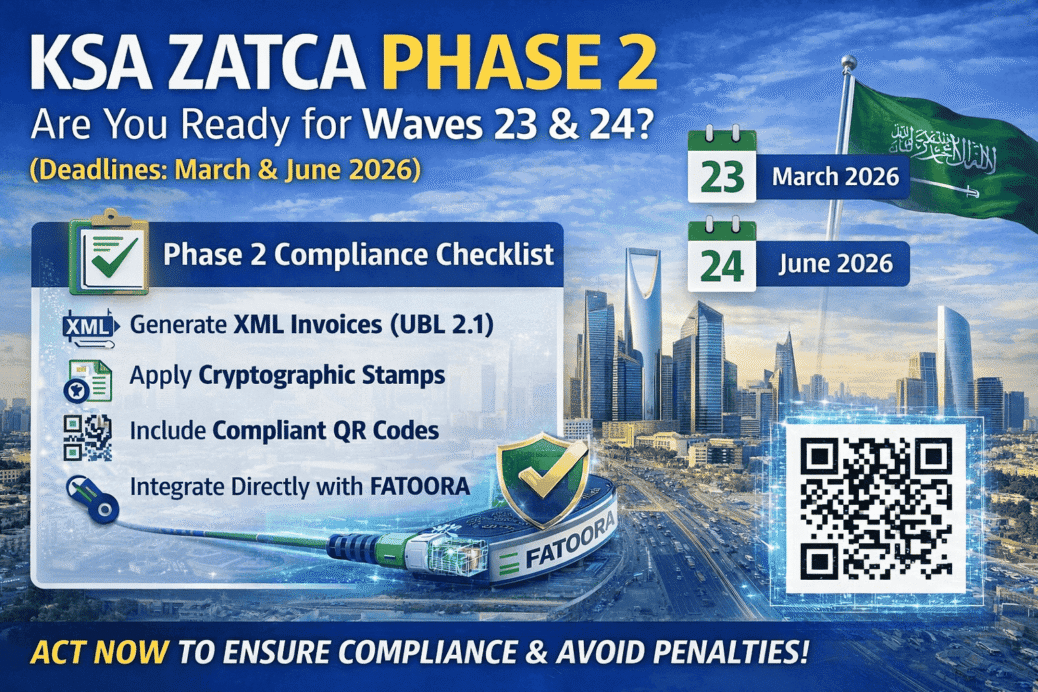
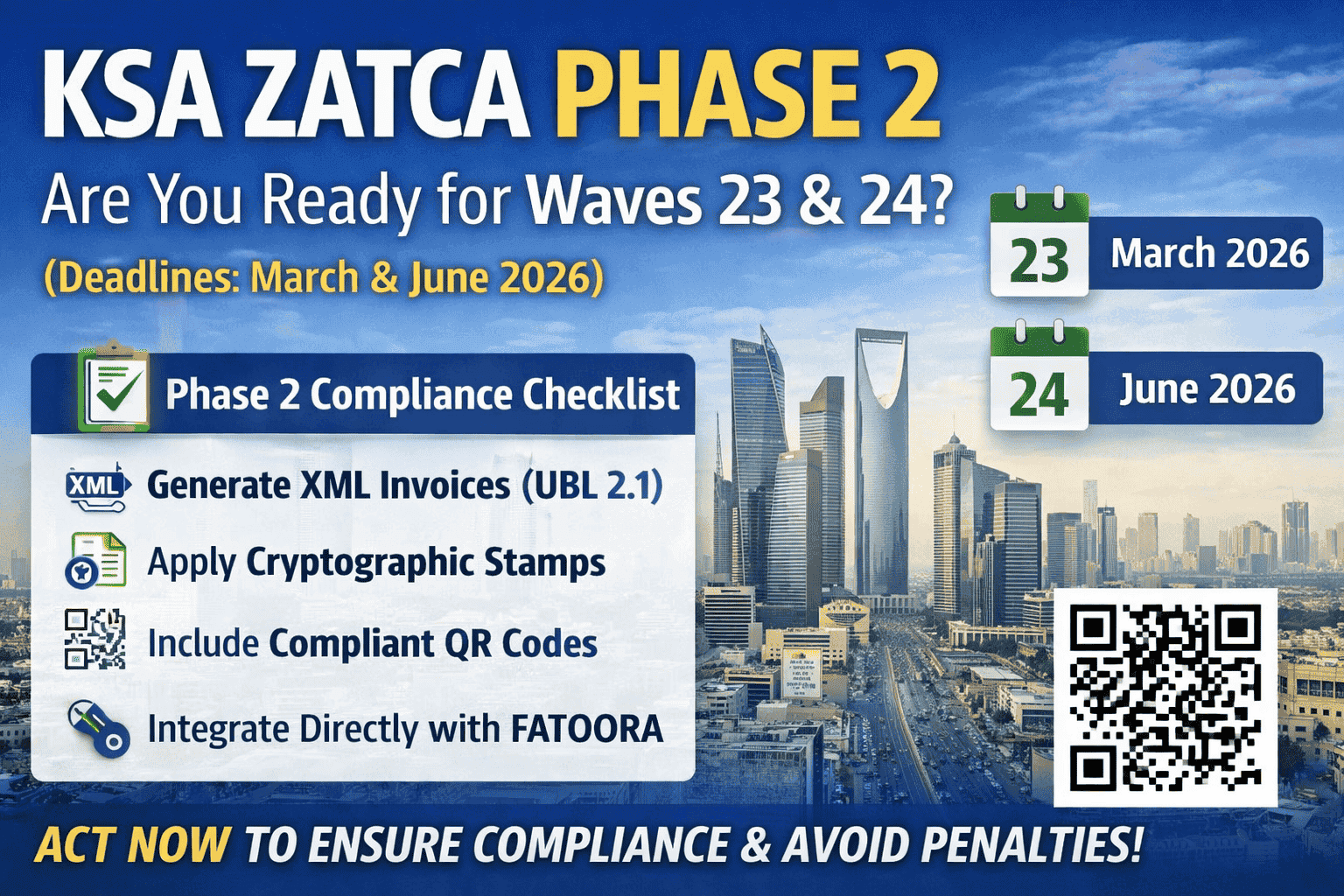
If your organization is included in Waves 23 or 24, your systems must be technically compliant before your enforcement date.
KSA ZATCA Phase 2 Waves 23 & 24: What Businesses Must Know
ZATCA is implementing a wave-based rollout, notifying taxpayers based on revenue thresholds.
Wave 23 – Compliance Deadline: March 2026
Wave 24 – Compliance Deadline: June 2026
If your company is notified:
-
Integration testing must begin immediately
-
ERP upgrades cannot be delayed
-
Vendor coordination becomes urgent
Businesses often require several months for full readiness.
Why KSA ZATCA Phase 2 Is Generating Massive Search Demand
Each new wave creates:
-
Thousands of compliance searches
-
ERP integration inquiries
-
Technical documentation downloads
-
Consulting requests
Businesses are searching for:
-
“ZATCA Wave 23 requirements”
-
“ZATCA Phase 2 XML format”
-
“ZATCA cryptographic stamp implementation”
-
“ZATCA QR code specifications”
The urgency is real — and growing.
KSA ZATCA Phase 2 Technical Requirements Explained Simply
1. Structured XML Invoice Generation
Invoices must be generated in UBL 2.1 XML format, compliant with ZATCA schema.
Your system must:
-
Generate mandatory invoice fields
-
Apply correct VAT calculations
-
Follow ZATCA data dictionary
-
Validate against XML schema before submission
Manual PDF generation is no longer sufficient.
2. Cryptographic Stamp (Digital Signature)
Each invoice must include:
-
A cryptographic stamp
-
Hashing mechanism
-
Device-based certificate
-
Secure key storage
This ensures:
-
Invoice authenticity
-
Tamper protection
-
Legal validity
Improper certificate management is one of the most common failure points.
3. QR Code Implementation
For simplified tax invoices (B2C):
QR codes must include:
-
Seller name
-
VAT registration number
-
Timestamp
-
Invoice total
-
VAT total
-
Cryptographic stamp
Incorrect QR encoding leads to compliance rejection.
4. Real-Time Clearance & Reporting
-
Standard invoices (B2B) → Clearance required before sharing with buyer
-
Simplified invoices (B2C) → Report within 24 hours
Your system must integrate directly with ZATCA APIs.
KSA ZATCA Phase 2 Compliance Checklist (Wave 23 & 24)
Technical Readiness Checklist
-
ERP capable of generating UBL XML
-
Secure cryptographic stamp integration
-
Device onboarding completed
-
API connectivity with FATOORA platform
-
Invoice hash chaining enabled
-
QR code compliant with ZATCA structure
-
Sandbox testing completed
-
Production certificate issued
Operational Readiness Checklist
-
Finance team trained
-
IT security review completed
-
Vendor invoices aligned
-
Backup & archiving policy compliant
-
Audit logs activated
Old vs. New: Pre-Phase 2 vs KSA ZATCA Phase 2
| Feature | Pre-Phase 2 (PDF-Based) | KSA ZATCA Phase 2 |
|---|---|---|
| Invoice Format | PDF / Printed | Structured XML (UBL 2.1) |
| Validation | Post-audit | Real-time clearance |
| Signature | Manual approval | Cryptographic stamp |
| QR Code | Optional | Mandatory (B2C) |
| Tax Authority Integration | None | Direct API integration |
| Fraud Prevention | Reactive | Embedded cryptographic controls |
Conclusion: Phase 2 transforms invoices into controlled digital tax documents.
Real-World Use Cases in Saudi Arabia
Manufacturing Company – Riyadh
High invoice volumes across distributors.
After Phase 2 integration:
-
Automated XML validation
-
Reduced invoice rejection rates
-
Faster distributor payments
Retail Chain – Jeddah
Thousands of B2C transactions daily.
ZATCA-compliant QR codes ensured:
-
Immediate compliance
-
Reduced manual reconciliation
-
Streamlined reporting
Construction Enterprise – Dammam
Complex project billing cycles.
Phase 2 integration provided:
-
Secure clearance workflows
-
Automated VAT reporting
-
Centralized compliance monitoring
How KSA ZATCA Phase 2 Differs from PEPPOL Models
Unlike PEPPOL’s 5-corner interoperability framework used in Europe and UAE, KSA uses a centralized clearance model.
Key difference:
-
PEPPOL = decentralized Access Points
-
ZATCA = centralized tax authority validation
However, both emphasize:
-
Structured data
-
Real-time validation
-
Compliance by design
Common Mistakes Businesses Make
-
Waiting for final month before integration
-
Assuming ERP is automatically compliant
-
Ignoring certificate lifecycle management
-
Testing only in production
-
Underestimating QR encoding requirements
Early implementation reduces compliance risk significantly.
Frequently Asked Questions
1. How do I know if my company is in Wave 23 or 24?
ZATCA sends official notifications through its portal. Monitor communications carefully.
2. Can we continue issuing PDFs?
PDFs may be shared visually, but legal invoices must be XML-based and cleared.
3. How long does implementation take?
For mid-to-large enterprises, several months depending on ERP complexity.
4. What happens if invoices fail clearance?
They cannot be legally issued until corrected and cleared.
5. Is cloud software allowed?
Yes, provided it meets ZATCA’s technical and security requirements.
Data-Driven Insight: Why Early Integration Matters
Markets that implemented real-time clearance systems have seen:
-
Significant VAT reporting accuracy improvements
-
Reduced tax gaps
-
Faster dispute resolution cycles
-
Increased transparency in supply chains
Businesses that integrated early experienced smoother transitions and fewer rejected invoices.
Internal Linking Opportunities
Suggested anchor texts:
-
“ZATCA Phase 2 integration services”
-
“KSA e-invoicing compliance solution”
-
“FATOORA API integration guide”
-
“cryptographic stamp implementation support”
Final Word: Waves 23 & 24 Will Not Be Delayed
March 2026.
June 2026.
If you are included in KSA ZATCA Phase 2 Waves 23 or 24, the time to act is now.
Compliance is technical.
Integration is complex.
But preparation makes it manageable.
Partner With VFTWorld for Full KSA ZATCA Phase 2 Compliance
VFTWorld provides:
-
Complete ZATCA Phase 2 integration
-
XML & UBL configuration
-
Cryptographic stamp setup
-
QR code compliance
-
ERP integration (SAP, Oracle, Dynamics, custom systems)
-
Multi-country compliance across UAE FTA, Qatar, Bahrain, Oman, GCC, and global PEPPOL frameworks
Do not wait for rejection errors.
Prepare. Integrate. Clear with confidence.
Contact VFTWorld today and secure your KSA ZATCA Phase 2 compliance before Waves 23 & 24 deadlines arrive.