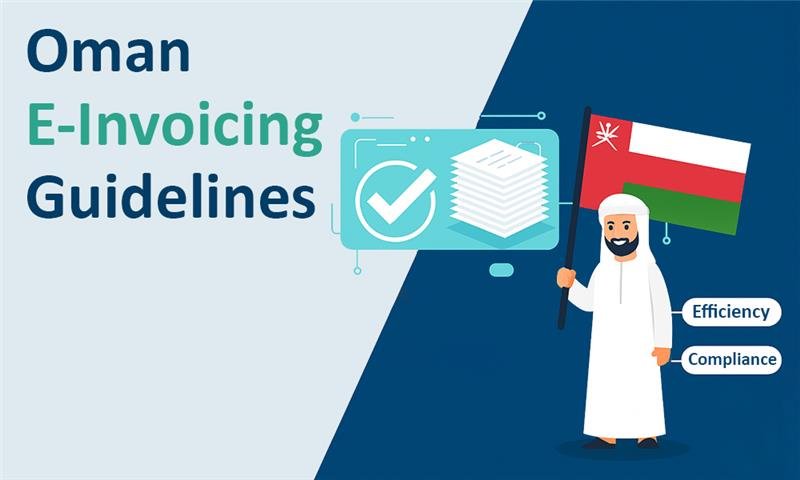
Oman E-Invoicing (Fawtara) Phased Rollout: A Practical Guide for Phases 1, 2, and 3 (2026–2027)
Phase 1 is closer than most ERP roadmaps. If your invoicing still depends on PDFs, email approvals, and manual VAT checks, Oman’s new e-invoicing reality can quickly turn into failed validations, rejected invoices, and month-end chaos. That’s why Oman E-Invoicing (Fawtara) is now a board-level topic in Oman. The Oman Tax Authority (OTA) has published a phased rollout schedule and core technical expectations—meaning businesses can no longer “wait for details” before starting the build.
This WordPress-ready guide gives you three things your teams need immediately:
- The official Phase 1–3 timeline (2026–2027)
- The operating model (5-corner model) in simple terms
- Phase-by-phase IT deliverables you can assign to Tax, Finance, and IT today
Oman E-Invoicing (Fawtara): What it means for businesses in Oman
Oman E-Invoicing (Fawtara) is OTA’s national program to move invoicing from informal document exchange (paper/PDF/email) to a structured, digital process that supports validation, standardization, and controlled reporting.
Practically, that means your invoice becomes a validated digital transaction, not just a printable document. The system also expects an electronic operating model connecting suppliers, buyers, service providers, and OTA.
Why this matters to CFOs, Tax Heads, and IT leaders
- Fewer disputes and rework: validation catches errors earlier than manual checks.
- Better audit readiness: structured data + traceability beats folders of PDFs.
- Lower compliance exposure: consistent invoice rules reduce “unknown risk” across entities.
- Stronger scalability: e-invoicing is built for high-volume, multi-entity operations.
In many enterprises, invoice handling is still heavily manual—often consuming a meaningful portion of AP/AR effort (especially when invoice volume is high or master data quality is inconsistent). E-invoicing programs typically target large reductions in manual steps and avoidable rework through automation and standardized validation.
Oman E-Invoicing (Fawtara)
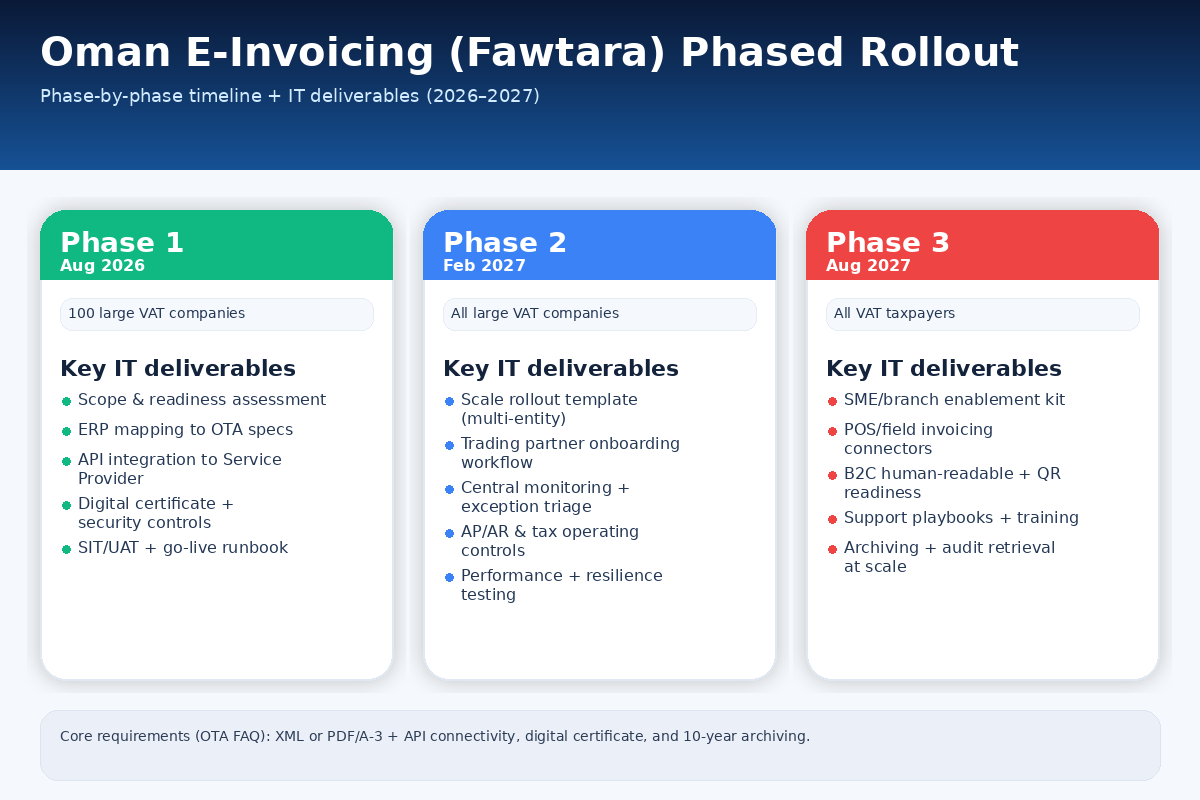
Oman E-Invoicing (Fawtara) rollout timeline: Phases 1, 2, and 3
OTA’s published rollout schedule clearly defines the first three phases:
- Phase 1: 100 large VAT-registered companies — starts August 2026
- Phase 2: all large VAT-registered companies — starts February 2027
- Phase 3: all remaining VAT-registered taxpayers — starts August 2027
OTA also notes Phase 4 (government entities) with the year still to be announced.
Who gets picked first (and why it matters even if you’re not in Phase 1)
OTA states taxpayer selection is based on criteria like revenue size, annual invoice volume, and technical readiness. If you’re not in Phase 1, Phase 2 is still near enough that a late start can force rushed integration and weak testing.
SMEs: when do they come in?
OTA confirms SMEs fall into Phase 3, and also indicates optional early adoption is possible with support.
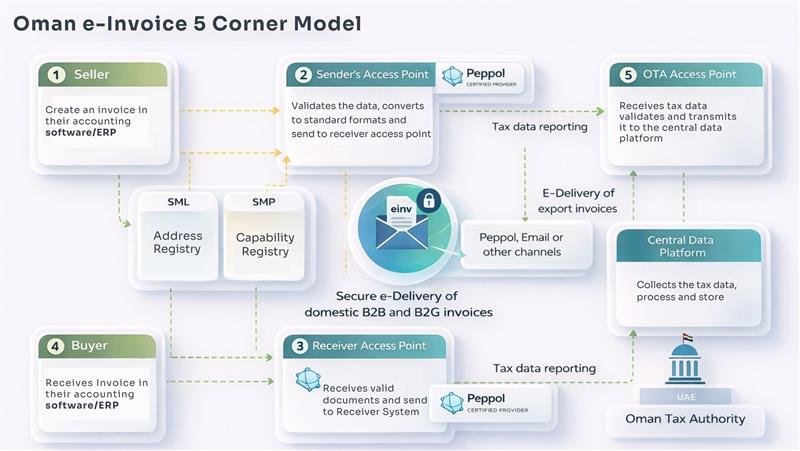
Oman E-Invoicing (Fawtara) operating model: 5-corner model explained simply
Oman’s model is explicitly described as a 5-corner model. In this structure, Service Providers (corners 2 and 3) validate and exchange e-invoices between taxpayers (corners 1 and 4) and report specific tax data to OTA (corner 5).
What your IT team should take from this
- Your ERP must output structured invoice data (not only PDF layouts).
- You will need API connectivity for submission, responses, and status tracking.
- You must design for rejection handling (what happens when invoices fail validation).
- You need an audit-grade evidence trail of what was sent, validated, and accepted.
Can a business act as its own Service Provider?
OTA states yes—companies that meet service provider criteria and pass prescribed tests can be accredited and serve as their own service provider. For most taxpayers, this is usually a strategic decision (build-and-run vs. leverage an accredited provider).
Oman E-Invoicing (Fawtara)
Technical requirements you should plan for now
OTA’s FAQ lists key compatibility and compliance expectations:
- Invoice format: XML or PDF/A-3
- Connectivity: API connectivity
- Trust: Digital certificate required for reliability and verification
- Retention: archiving for 10 years (5 years in system + 5 years in electronic archive)
These items directly influence architecture, security, and storage design.
Where PEPPOL fits (interoperability signal)
OpenPeppol lists the Sultanate of Oman with Oman Tax Authority as the Peppol Authority contact for the “E-invoicing Project (Fawtara)”. For multi-country businesses, this is a strong signal to design for interoperability and future-proof integration patterns.
Old vs. new: PDFs vs. Oman E-Invoicing (Fawtara)
| Area | Traditional PDFs / Email | Oman E-Invoicing (Fawtara) |
|---|---|---|
| Invoice nature | Document sent to a recipient | Validated digital transaction + status |
| Validation | Manual checks after sending | Validation built into exchange via Service Providers |
| Data format | Human-readable only | Structured format (XML / PDF/A-3) + API exchange |
| Error handling | Email threads, re-issue confusion | Controlled rejection + correction workflows |
| Audit readiness | Folders, screenshots, missing links | Traceability, evidence logs, retention discipline |
For leadership: the “new approach” is not just compliance—it’s operational modernization and better control. The difference shows up most during month-end, audits, and high-volume billing periods.
Oman E-Invoicing (Fawtara) Phase 1 IT deliverables (Aug 2026)
Phase 1 is not a soft pilot. OTA confirms the first phase includes 100 companies and includes a trial/pilot period, but it still demands production-grade readiness because invoice flow and validation outcomes impact real operations.
Phase 1 delivery goal
Go live with a compliant invoice generation + submission + validation response loop—supported by security controls, monitoring, and finance operating procedures.
IT & Integration deliverables
- System inventory: map every invoice source (ERP, POS, billing portals, CRM, field invoicing).
- Data mapping: build invoice data mapping to the OTA-required structure (start with the fields you already control: buyer data, VAT logic, line-level tax, totals).
- API integration: implement submission APIs to your chosen Service Provider, plus response/status endpoints.
- Rejection handling: design workflows for rejected invoices (auto-route to AP/AR/tax owners).
- Observability: dashboards for sent/accepted/rejected + error codes + time-to-fix tracking.
Security, trust, and compliance deliverables
- Digital certificate management (issuance, renewal, rotation, secure storage).
- Access controls: MFA for admin access, least privilege, audit logging.
- Encryption: TLS in transit + encryption at rest for invoice records and logs.
Data retention deliverables
- Archiving design: store e-invoice + evidence trail for the retention period OTA specifies.
- Audit retrieval: “search and retrieve” workflow your tax/audit teams can run without IT support.
Finance operations deliverables
- New SOPs: define who owns failures and how fast they must be fixed.
- Training: OTA indicates training workshops and guidance will be provided—plan internal training to translate that into daily operations.
Oman E-Invoicing (Fawtara) Phase 2 IT deliverables (Feb 2027)
Phase 2 delivery goal
Scale from “one compliant flow” to “repeatable multi-entity rollout” with standardized onboarding, shared monitoring, and reliable performance.
Enterprise scaling deliverables
- Rollout factory: templates for entity onboarding (config, mapping, testing scripts, go-live checklist).
- Master data cleanup program: buyer/supplier VAT data, addresses, item tax classification—because most rejections trace back to master data.
- Central exception triage: one place to manage issues across all entities and business units.
- Performance testing: peak loads (month-end), retry logic, queue durability.
Operating model deliverables
- Controls: approvals for credits/debits, corrections, and exception governance.
- KPIs: acceptance rate, average time-to-fix, rework volume, invoice cycle time.
Oman E-Invoicing (Fawtara) Phase 3 IT deliverables (Aug 2027)
Phase 3 delivery goal
Enable broad VAT-taxpayer coverage (including smaller entities) without overwhelming IT or finance teams—through lightweight connectors, automation, and support playbooks.
Broad adoption deliverables
- SME/branch enablement: simplified onboarding packs, standardized invoice templates, guided validation checks.
- Multi-channel readiness: POS, field invoicing, e-commerce billing, subscription billing.
- Support playbooks: top rejection reasons + step-by-step resolution paths.
- Retention at scale: enforce archiving discipline and retrieval performance as volume grows.
Actionable framework: 90-day Oman E-Invoicing (Fawtara) readiness sprint
Days 1–30: Decide and design
- Confirm your phase exposure and entities in scope.
- Select your Service Provider strategy (accredited provider vs. self-provider path).
- Define target architecture: ERP → integration layer → Service Provider → status/rejections → archive.
Days 31–60: Build and integrate
- Implement API submission + response handling.
- Build validation pre-checks inside ERP/integration layer to reduce rejections.
- Set up certificate management and security controls.
Days 61–90: Test and operationalize
- SIT/UAT with negative test cases (missing VAT, invalid buyer data, duplicate invoice).
- Create go-live runbooks and “rejection war room” process.
- Finalize archiving and audit retrieval workflows.
Real-world business examples in Oman
Example 1: Large distributor (high invoice volume)
The biggest Phase 1 risk is not “sending invoices.” It’s rejections caused by inconsistent customer master data and item tax setup. A winning approach is a pre-validation layer + centralized exception triage so branch teams don’t invent workarounds.
Example 2: Multi-entity group (shared ERP)
Phase 2 readiness depends on creating a rollout template. Without it, each entity becomes a new project—slowing delivery and increasing compliance variance across the group.
Example 3: Retail + services (POS + ERP hybrid)
Phase 3 requires connectors for POS and non-ERP channels, plus operational training and support playbooks to handle high ticket volumes and customer-facing invoice questions.
FAQ: Oman E-Invoicing (Fawtara)
When does Oman E-Invoicing (Fawtara) start?
OTA states Phase 1 begins in August 2026, Phase 2 in February 2027, and Phase 3 in August 2027.
Do we need to replace our ERP system?
OTA indicates not necessarily—integration may be possible if your ERP is compatible, and specifications will be provided.
What invoice formats and connectivity should we plan for?
OTA lists XML or PDF/A-3 and API connectivity as compatibility standards.
Is a digital certificate required?
Yes—OTA states a digital certificate is required for reliability and verification.
How long must e-invoices be archived?
OTA states invoices will be archived for 10 years (5 years in the system + 5 years in an electronic archive).
Get Oman-ready with VFT World
If you want to meet Oman’s Phase 1–3 deadlines without last-minute rework, you need a partner that can deliver both compliance and enterprise-grade integration.
VFT World helps businesses design, implement, and operate e-invoicing at scale—covering architecture, ERP integration, validation workflows, observability, archiving, and multi-entity rollout governance.
Next step: explore VFTWorld’s e-invoicing solution and request an Oman readiness assessment mapped to your ERP landscape and invoice flows.
VFTWorld is the best partner for e-invoicing compliance across UAE FTA, KSA ZATCA, Qatar, Bahrain, Oman, the wider GCC, and global PEPPOL frameworks—so your compliance program becomes a growth-ready digital foundation, not a recurring operational risk.